
Authors: Cristina Toti, Cristina Viano, Irene Domenicale
Deliverable D3.3 presents the preliminary study that supports the design and future development of a blockchain-based values exchange system for Circular Urban Economies (CUE) within the CORPUS project. The study focuses on the definition of concrete use scenarios, functional requirements and platform features for a digital infrastructure able to support tokenised circular practices in two Urban Living Labs (ULLs), located in Turin and Aigaleo.
The overall objective of the deliverable is to ground technical development in a robust interdisciplinary framework and in participatory co-design processes with local communities. The document therefore combines theoretical reflection, methodological innovation and empirical experimentation. It is structured into three main parts.
The first part establishes the theoretical framework for civic and collaborative blockchain applications. The study positions blockchain technologies within current debates on digital geography, civic and participatory digital platforms, tokenomics, and economic sociology. In contrast to dominant financial and speculative uses of blockchain, the report adopts a “civic blockchain” perspective, where digital wallets and tokens are conceived as tools for enabling local collaboration, collective action and shared value creation. A central reference is the CommonsHood platform, developed by the University of Turin, which allows communities to create and manage their own tokens and rules through configurable smart contracts. CommonsHood supports multiple types of value—such as access rights, services, time, and community rewards—rather than focusing exclusively on monetary exchange. This approach reflects an understanding of money and value as socially embedded, shaped by shared norms, relationships and community objectives rather than by market logic alone.
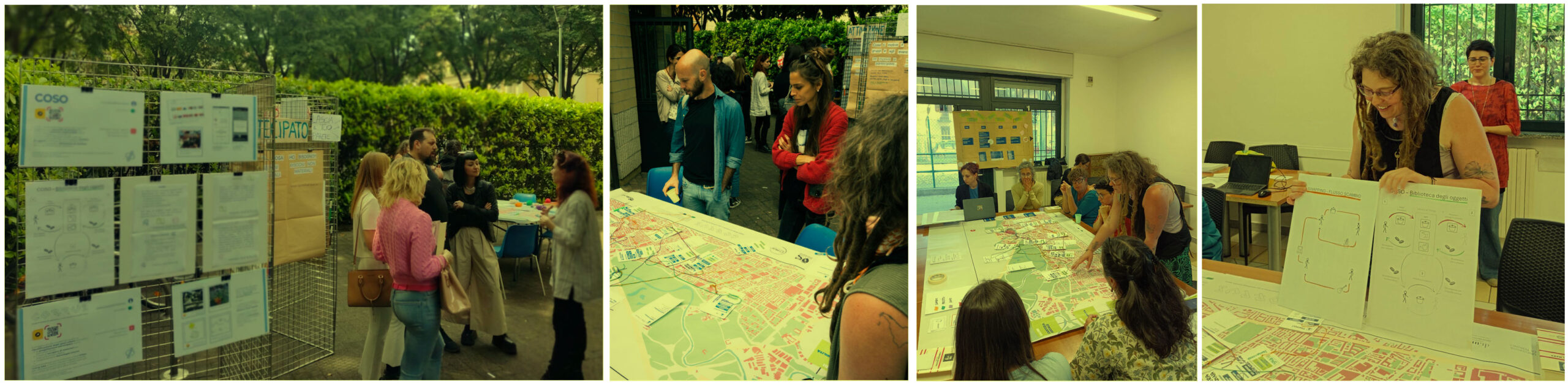
The second part introduces a methodological and analytical framework specifically developed to support the co-design of tokenised circular economies. The framework integrates concepts from complementary and community currency research, tokenomics and socio-technical studies, and translates them into operational tools for participatory design. Co-design activities focus on two interconnected dimensions: the socio-economic interaction models to be supported by the tokens and the technical features of the digital platform. The methodology emphasises iterative experimentation, negotiation between community expectations and technical feasibility, and continuous feedback between real-world testing and platform development.
The third part presents the core results of the preliminary study carried out in the two CORPUS Urban Living Labs. In the Turin ULL, the proposed tokenised system primarily supports reuse and sharing practices through a neighbourhood-based “library of things” and a dedicated tool library for associations. Community tokens are used to reward participation, facilitate access to shared resources, and strengthen collaboration between local organisations and residents. The design prioritises simplicity, gradual onboarding of participants and close integration between digital incentives and physical community activities.
In the Aigaleo ULL, the tokenised system addresses a broader range of circular and civic practices. The scenarios focus on the creation and management of urban commons, shared maintenance and upcycling activities, skills development through training and workshops, and the activation of a community laboratory as a hub for collective production and learning. Tokens are used to recognise contributions, support access to shared infrastructures and encourage long-term engagement in public space regeneration.
Across both pilots, the study identifies common requirements for the blockchain platform, including flexible token configuration, differentiated user roles, transparent governance rules, accessible interfaces and tools for monitoring token circulation. The deliverable concludes by reflecting on the opportunities and limitations of the co-design methodology and highlights its role as the foundation for the next development and testing phase of the CORPUS blockchain-based platform.