
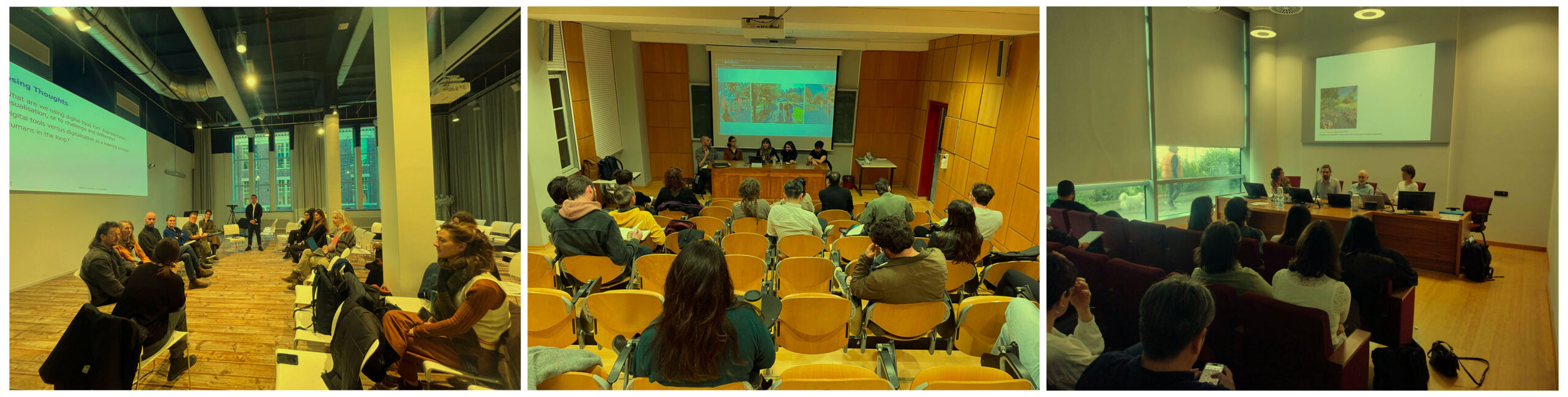
A series of public symposiums accompanying the CORPUS consortium meetings in Delft, Athens and Turin.
Authors: CORPUS Research Team
Alongside its consortium meetings, the CORPUS project has organised a public symposium — in Delft, Athens and Turin — opening its research to the academic communities and practitioners working in each host city. Each volume was designed as a space to connect with local expertise, encounter different disciplinary and professional approaches to circular and emancipated urban futures, and reflect collectively on the project’s ongoing work in Aigaleo and Turin. Beyond the exchange of ideas, these events have also become a point of contact between CORPUS and a wider network of researchers, designers, cooperatives and civic initiatives, several of whom have gone on to inform the project’s thinking well beyond the day of the symposium itself. Read on for the themes, presentations and speakers of each of the three volumes.
CORPUS Discussions Vol. I — Circular Retrofitting of Public Space: Infrastructures, Models, Strategies
30 January 2025, 13:00–17:00 · Berlagezaal 1, Faculty of Architecture and the Built Environment, TU Delft
The first in the CORPUS Discussions series opened the project’s academic dialogue on circular urban economies, bringing together researchers and practitioners working at the intersection of material reuse, public space and urban planning. Held on the first day of the second CORPUS consortium meeting — preceded in the morning by an internal Executive Board meeting and a WP3/WP5 workshop — the symposium set out to share cutting-edge research on how cities can retrofit their public spaces through circular, phygital models of cooperation, from the reclamation of physical materials to the digital and organisational tools needed to scale reuse practices.
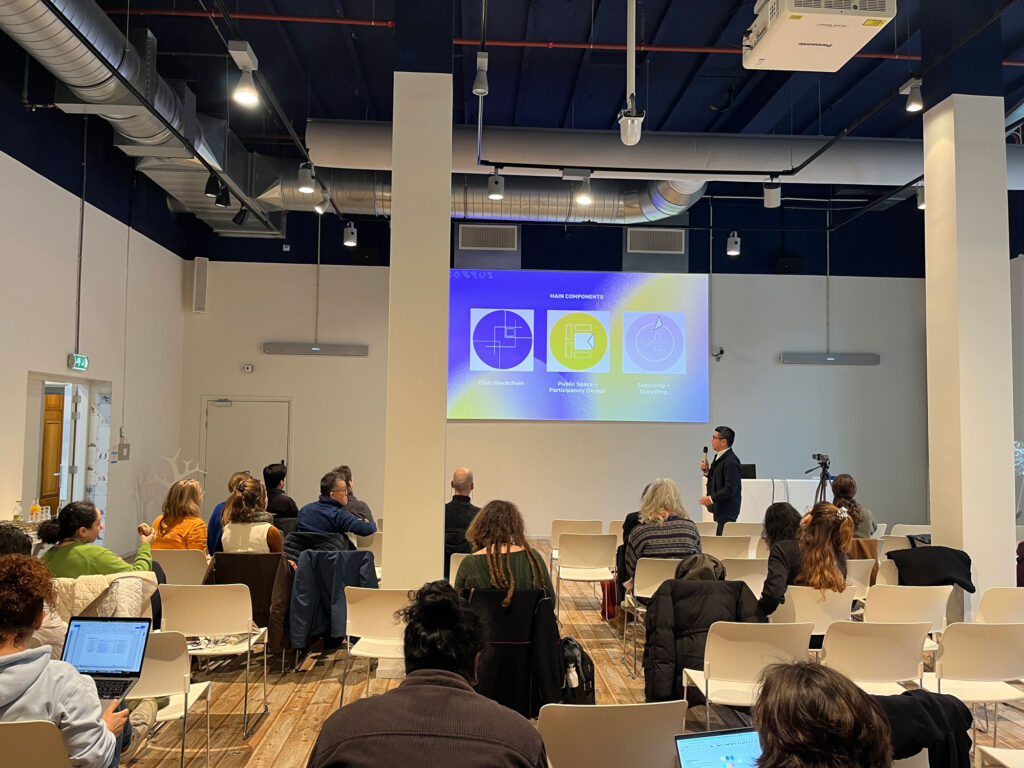
After a welcome from Víctor Muñoz Sanz and Cinco Yu of TU Delft’s Urban Design section, Cristina Viano (UNITO) together with Giannis Zgeras and Vily Mylona (Open Lab Athens) introduced the CORPUS project and its two Urban Living Labs in Aigaleo and Turin.
Gaspard Geerts (Rotor) — “Learning from physical stocks of reused materials.” Geerts presented Rotor’s practice-based philosophy of reuse: dismantle, clean and stock, then reuse — an approach that treats existing buildings as material banks and follows design-for-reconstruction principles from the outset. He drew on two Interreg NWE projects Rotor has participated: FCRBE, which set out to increase the circulation of reclaimed building elements across north-west Europe, with all documentation gathered on the Opalis platform, and its successor PREUSE, which supports local and regional public authorities in setting up reuse centres and building the construction sector’s capacity to reclaim and reuse building materials. Geerts argued that, at this stage, digitalisation contributes little to the practical work of reuse — the bottleneck remains physical logistics and craft knowledge, not data systems. Geerts is an architect who joined the Rotor team in 2018 as a project manager for design, design-assistance, exhibition and research projects, having graduated that year from the Faculty of Architecture La Cambre Horta of the Free University of Brussels.
Quirien Reijtenbagh (TU Delft) — “Circular Strategies for Municipal Public Space.” Reijtenbagh presented circular business models for materials used in the public realm, developed with the Amsterdam public sector as a case study, and argued that temporary uses offer a practical answer to a persistent problem: materials that cannot pass the quality or safety tests required for permanent reinstallation can still find a productive second life in temporary applications. Reijtenbagh is a PhD researcher in the Faculty of Architecture and the Built Environment investigating the value of applying circular solutions in public space, and lectures on Circular Economy, Transition Studies, Systems Thinking and Sustainability; her research more broadly examines how effective use of urban space can support material circularity in outdoor public spaces.
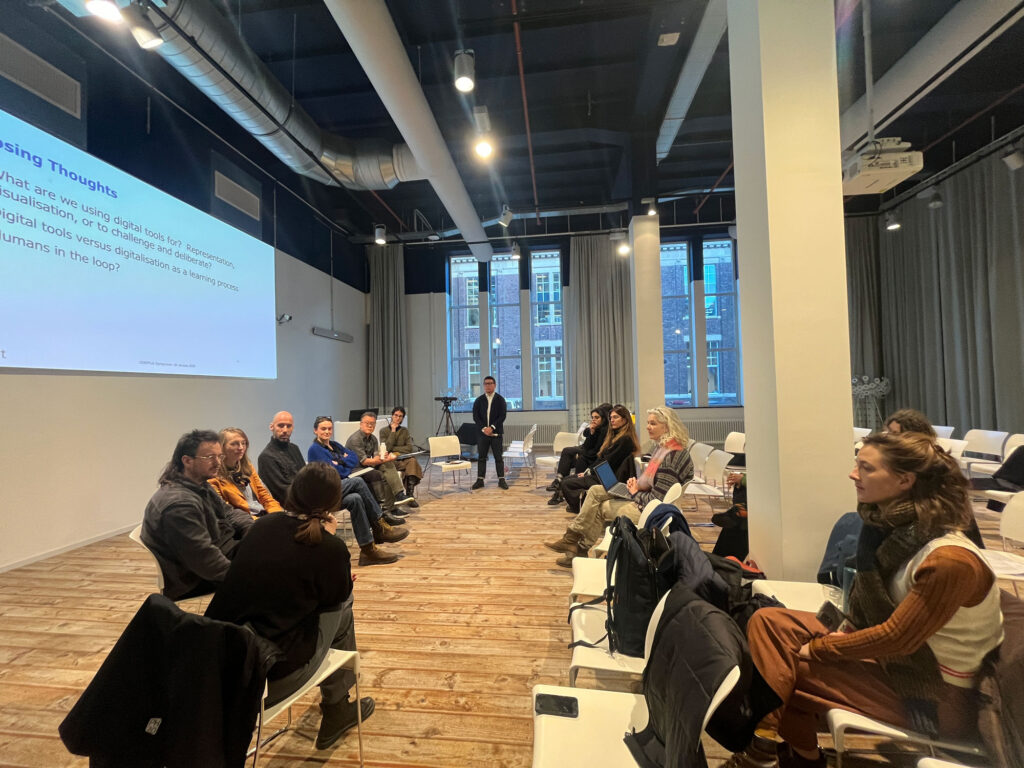
Paul Chan & Eline Baert (TU Delft) — “Circular Collaboration (CirCol): Delivering Circular Renovation at Scale through Multi-Cycle, Multi-Scalar, and Multi-Level Collaboration.” Chan and Baert examined circular design and construction management as something achieved through the everyday micro-practices of the actors able to shift social practice on the ground, connecting these to the meso-level reconfiguration of activities and systems, and ultimately to macro-level shifts in the values of the construction industry as a whole. Chan is Professor of Design and Construction Management in the Faculty of Architecture and the Built Environment, researching how people navigate organisational, social and technological change in sustainability transitions, and leads CirCol, an NWO-funded project on collaboration in circular renovation in the Dutch social housing sector. Baert is a PhD candidate in the Management in the Built Environment department, whose research within CirCol explores how renovation projects reshape not only buildings but the roles, relationships and responsibilities of everyone involved.
CORPUS Discussions Vol. II — Emancipation of Construction / Construction of Emancipation
Thursday, 20 November 2025, 17:00–20:00 · School of Architecture, NTUA, Room M318
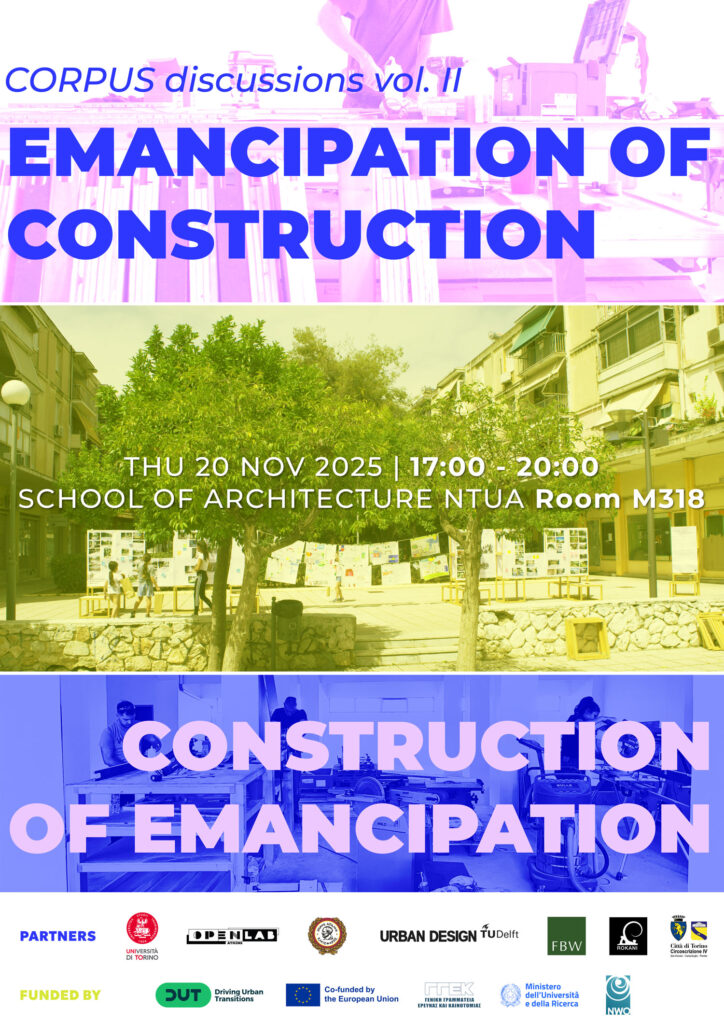
The second volume moved the discussion from Delft to Athens, and from material circularity to the project’s other founding premise: the emancipation of construction and the construction of emancipation. Framed around this twofold idea, the event opened up the different registers through which CORPUS pursues emancipation in practice — through making, urban pedagogy, digital civics and pattern language — and put the project’s own experience in dialogue with researchers working on spatial justice, children’s citizenship, commons-based production and civic infrastructure.
CORPUS Research Team — “Reflections and insights from Aigaleo and Turin Urban Living Labs.” The team opened the evening with a grounded account of what emancipation and re-appropriation have looked like in practice across the two Living Labs, setting the terms for the theoretical contributions that followed.
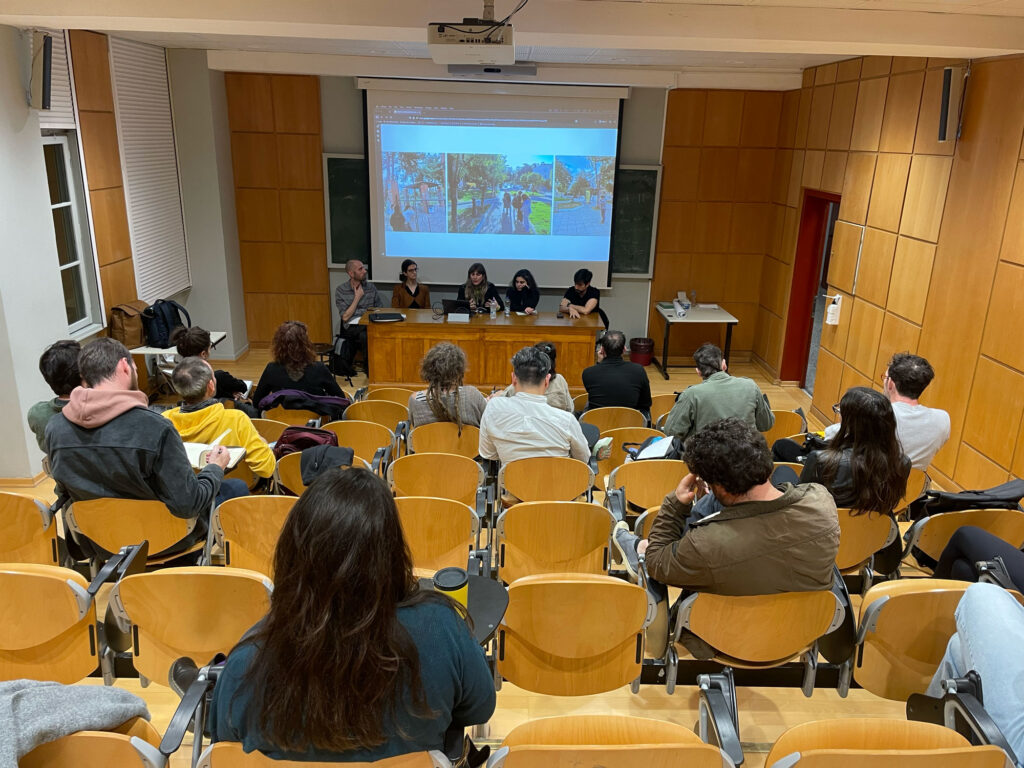
Penny Koutrolikou (Associate Professor, School of Architecture, NTUA) — “Tracing socio-spatial (in)justice within a crisis continuum.” Koutrolikou proposed a rethinking of growth and a critique of urban “fortressing,” arguing for figurations of political belonging and freedom in the city that can only ever be collective, never individual. She directs the Planning Methodology and Spatial Regulation Lab at NTUA and holds a PhD in Planning Studies from the Bartlett School of Planning, UCL, and an MA in Culture, Globalisation and the City from Goldsmiths; her research spans socio-spatial justice, urban crises and legal geographies of rights across Athens, Barcelona and Glasgow. NtuaNtua
Zoi Karampini (Architect-Researcher, PhD, NTUA) — “Tracing children’s practices in public space: appropriations, meanings & claims.” Karampini examined how children challenge adult authority in the city through wandering, exploratory, embodied practice, framing the act of making space with children as an inherently political one — part of a broader shift from a paradigm of child protection to one of child participation. She holds a PhD in Children’s Geographies from NTUA and is an adjunct lecturer at the Department of Geography, University of the Aegean, with research on children’s everyday practices in urban space, including how children’s play can be read as an everyday spatial practice that advances their claim to spatial justice.
Alexandros “Alekos” Pantazis (P2P Lab research collective; Assistant Professor, University of Thessaly) — “Cosmolocalism: the concept of ‘design global, manufacture local’ and its emancipatory characteristics.” Pantazis discussed the commons and the co-management of shared resources through the Tzoumakers project, describing an approach that learns from high-tech design while deliberately using low-tech means of production, exploiting mid-tech solutions locally, and pursuing the democratization of manufacturing. He is a Research Fellow at the P2P Lab, an interdisciplinary research hub and community-driven makerspace, and co-founded Tzoumakers, a farmer- and maker-run fablab in Epirus producing open-source agricultural tools as a working case of cosmolocalism and open cooperativism.
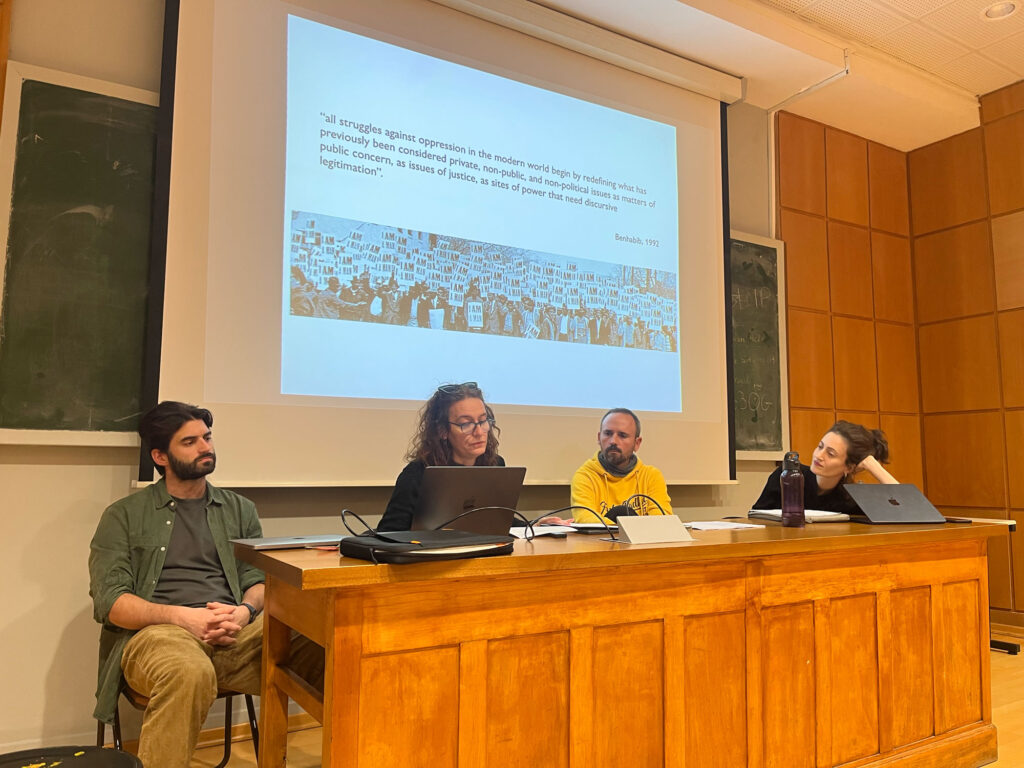
Vasilis Vlachokyriakos (Reader of Human-Computer Interaction and Digital Civics, Newcastle University) — “The Infrastructure of Emancipation — Creating the conditions of emancipation: methods, technologies, practices.” Vlachokyriakos introduced politics as infrastructure, arguing that emancipation is a material condition that communities co-create, and that making, learning and repairing are themselves ways of infrastructuring emancipation. He is a Human-Computer Interaction academic with a background in Computer Science and Computer Security, and Reader of HCI and Digital Civics at Newcastle University, where he co-leads the Open Lab research group; fittingly for the evening’s host institution, he is also a co-founder of Open Lab Athens itself.
CORPUS Symposium Vol. III — Urban Transitions: Research and Practices
Thursday, 16 April 2026, 15:00–17:00 · University of Turin, Campus Luigi Einaudi, Sala Lauree Rossa Piccola, Lungo Dora Siena 100/a, Turin
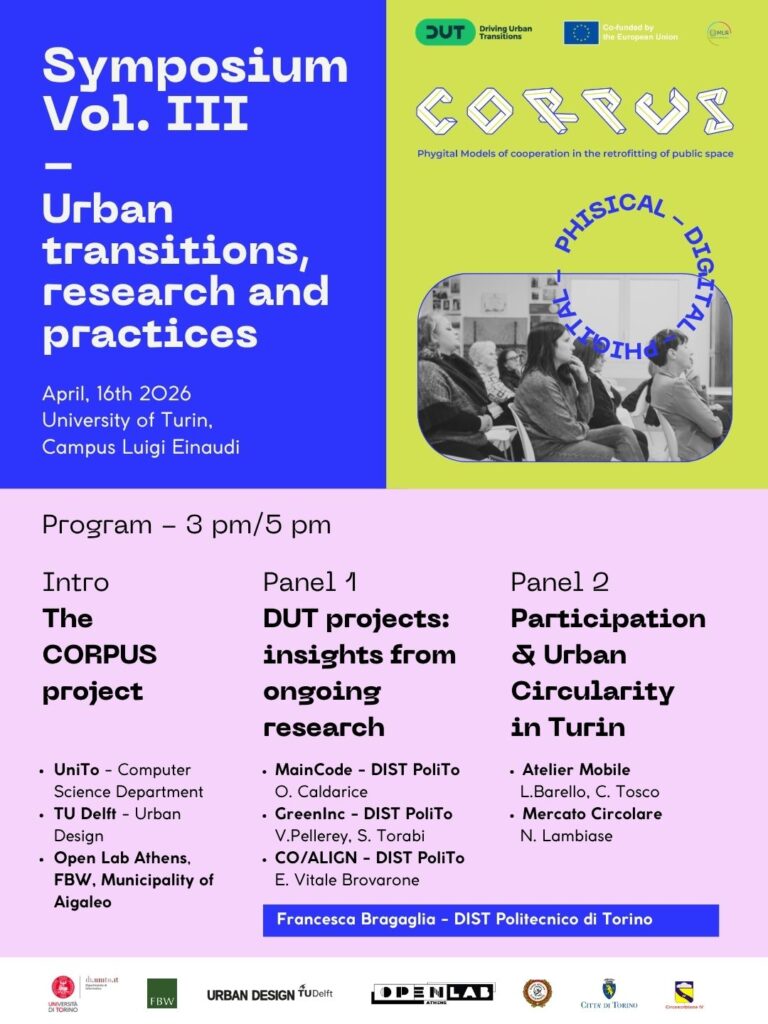
Held during the 4th CORPUS Meeting, the third and final volume of the symposium series turned from Delft’s focus on circular economy and urban planning, and Athens’ focus on emancipation and reappropriation, to a more outward-facing question: how can the results emerging across CORPUS and the wider Driving Urban Transitions (DUT) partnership be made accessible and relevant to real urban stakeholders — using Turin’s own experience as the test case. After an introduction to the CORPUS project by representatives of Università di Torino, Open Lab Athens, FBW, the Municipality of Aigaleo and TU Delft, the symposium unfolded across two panels.
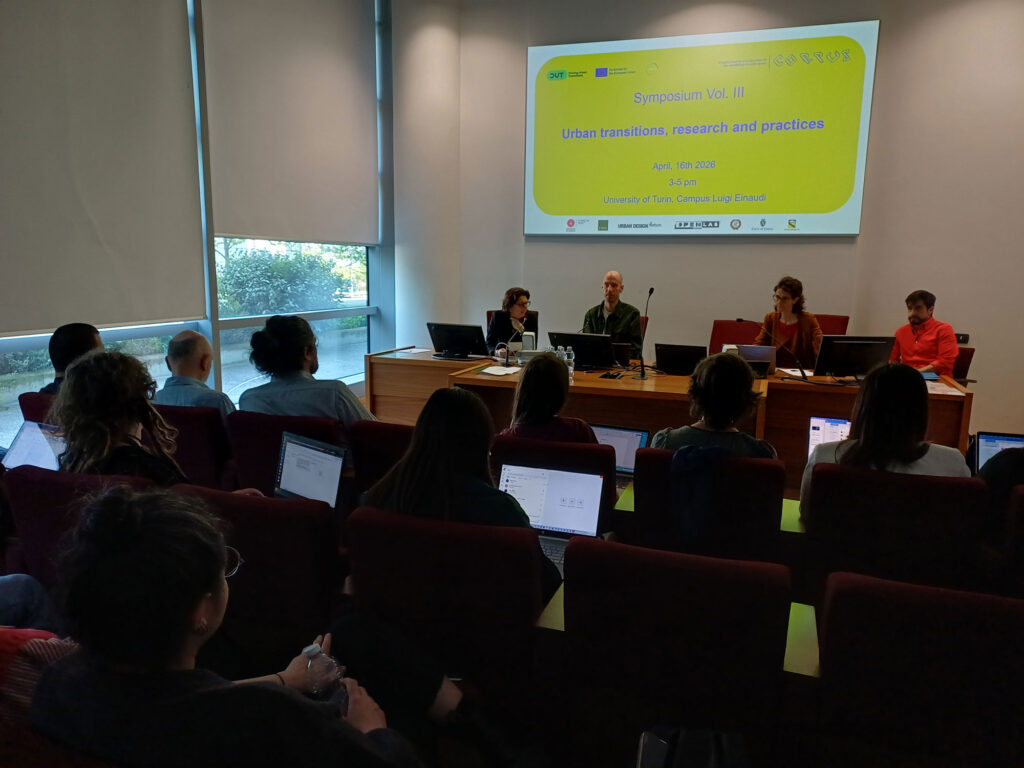
Panel 1 — Interdisciplinary research in the DUT framework in the city of Turin. Professor Elisabetta Vitale Brovarone (Politecnico di Torino, DIST) presented CO/ALIGN, on urban mobility transitions through coalitions of civil society organisations that bridge citizens and decision-makers within multi-level governance, with a strong focus on tactical urbanism and placemaking. Professor Ombretta Caldarice (Politecnico di Torino, DIST) presented MAINCODE, on transforming schoolyards into nature-based Urban Climate Shelters through co-design with children, local communities, policymakers and practitioners — framing these not as temporary refuges but as long-term public infrastructure linking climate comfort, social inclusion and regenerative urbanism. Professor Sara Torabi and Virginia Pellerey (Politecnico di Torino, DIST) presented GreenInc, examining how Inclusive Climate Actions can make nature-based solutions more socially equitable, evaluated through both effectiveness and socio-spatial justice, and supported by digital decision-support and spatial-visualisation tools.
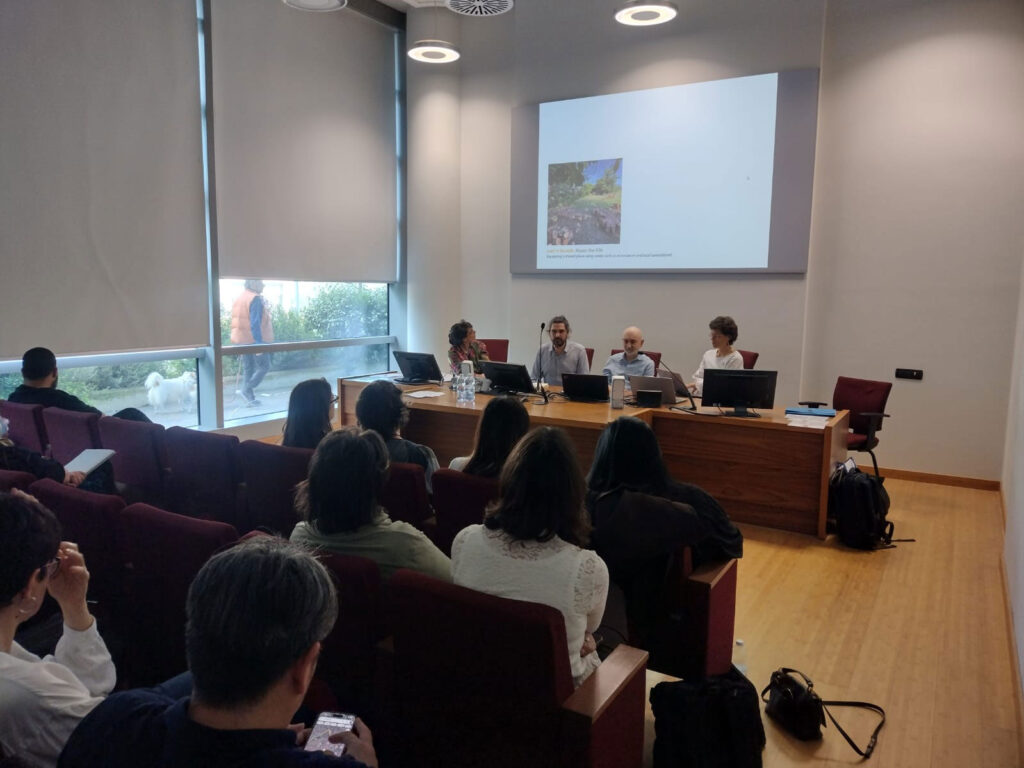
Panel 2 — Circular Urban Economies: from research to practice. Luca Barello and Cristian Tosco of Atelier Mobile discussed participatory design and circularity in Turin from the vantage point of practising designers and architects. Atelier Mobile is a cultural association founded and led by Barello — an architect and lecturer in architectural design at the Politecnico di Torino — that runs design-and-construction workshops directly in public space, working alongside communities and local craftspeople across Piedmont, the Alpine region and beyond. Nadia Lambiase of Mercato Circolare, a benefit company, presented crossmedial tools for training and public engagement around the circular economy. Founded in 2018 to spread the circular-economy paradigm through tools connecting consumers, businesses and institutions and to stimulate civic commitment, Mercato Circolare was founded by Lambiase, who holds a PhD in Innovation for the Circular Economy from the University of Turin.
The symposium closed with reflections from Professor Francesca Bragaglia (Politecnico di Torino, DIST), who framed co-production not simply as participation but as a deeper redistribution of urban agency — shared problem framing, shared implementation and shared responsibility for outcomes — arguing that this requires an ecosystem of enabling governance frameworks, relational capacities among actors, and enabling infrastructures, digital ones included.